

Common Evening Primrose
(aka Sundrop)
Oenothera biennis
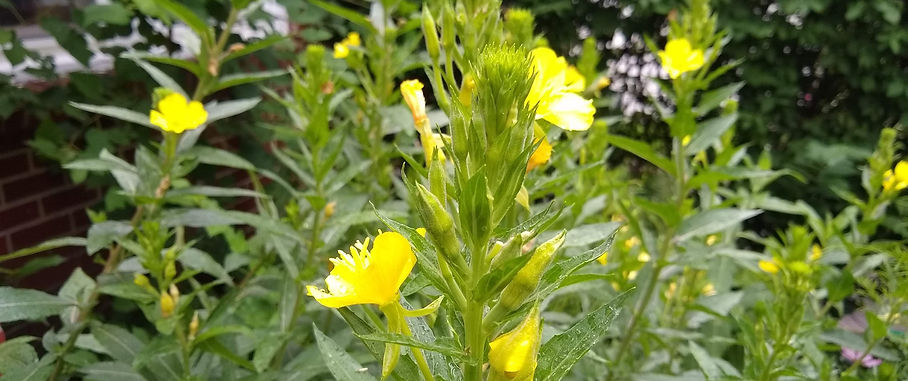
Common Evening Primrose is a tall-growing biennial wildflower native to eastern and central North America, related to commonly-cultivated sundrop varieties.

Common Evening Primrose is a beautiful native plant we first encountered in the Albany Pine Bush. The late summer meadows of the Rapp Barrens feature these towering plants with bright yellow flowers mixed among the goldenrod, pokeweed, Saint John's wart, and other wildflowers.
It's a member of the Oenothera genus which includes a number of common garden flowers also called "sundrops". Garden varieties tend to grow as densely blooming bushy plants, but O. biennis grows tall and lean, easily reaching heights of six feet (frequently more) with only a handful of blooms open at once. It normally only branches when the main stem is damaged.
The flowers are typically one to two inches across with four separate bright yellow petals and grow in a spike blooming close to the stem. They open in the last afternoon or evening and generally stay open until shortly after sunrise when they close and die.
The plants are biennial, meaning they typically live for two years. In the first year, they grow low to the ground as a rosette of leaves that might reach a diameter of about a foot but doesn't produce flowers. The foliage dies off by winter and in the second growing season, a stem emerges with smaller leaves, and eventually flower buds, growing in a spiral along its length.
The plant will generally die after its second season, though you may not notice because it is a prodigious self-seeder! The seeds are tiny black grains that grow by the hundreds inside small capsules which themselves can number in the dozens on each plant. These capsules will dry and turn brown as they ripen, eventually splitting open into four segments to let the seeds out.

Posts about Common Evening Primrose


